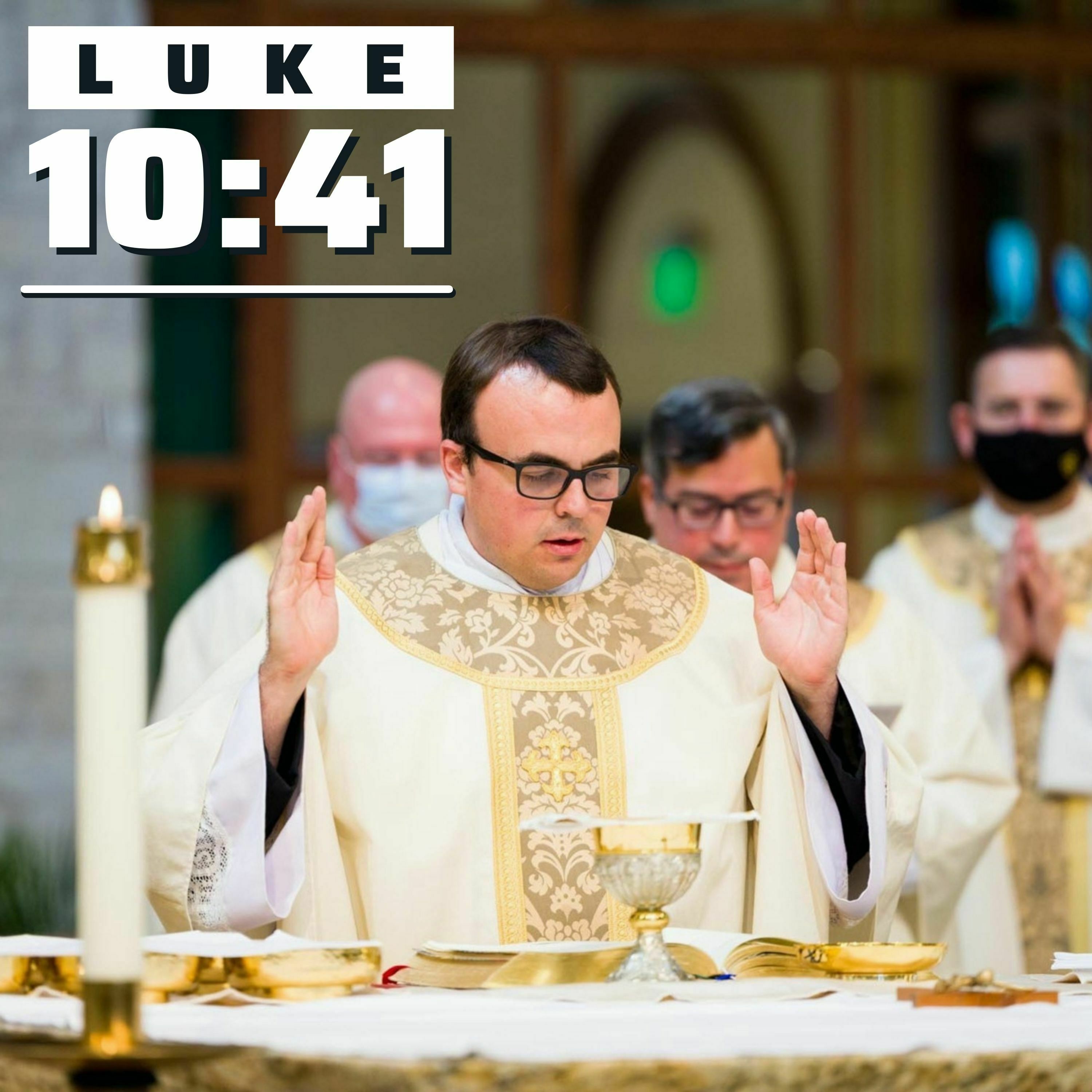
Envy: The Joy-Stealing Sin | Fr. Will Rooney | 4th Sunday of Lent – Luke 10:41
- Envy: The Joy-Stealing Sin | Fr. Will Rooney | 4th Sunday of Lent
- Living Water for the Wounded Heart: Lust and the Woman at the Well | Fr. Will Rooney | 3rd Sunday of Lent
- That They May Have Life | Part 4 – The Fifth Commandment: Life, Justice, and the Christian Citizen
- Rise and Do Not Be Afraid: The Transfiguration, Zeal, and Sloth | Fr. Will Rooney | 2nd Sunday of Lent
- Hungry for More: Gluttony & Greed | Dcn. Chris Haberberger | 1st Sunday of Lent
Dr. Gilley’s class was right after lunch. It was about fluid mechanics and try as I might, I often dozed off in the middle of the lectures. On one particularly humorous occausion, I fell asleep in the middle of the class working a problem. When I came too a few minutes later, still in a bit of a stupor, I was convinced that a mistake had been made, and I raised my hand and asked, “Dr. Gilley, don’t we need to divide by 27 to go from cubic feet to cubic yards?” The kind professor replied: “Son, we’re in the metric system. Go back to sleep.”
Now, many lessons could be drawn from that experience. The first of which is, as my friend in the class put it “be humble – don’t try and wake up and raise your hand.” But more importantly, is that because I feel asleep I wasn’t able to see the problem correctly. I missed a crucial aspect of the problem which should have informed my way of seeing it.
I remember also in engineering class, them telling us that once you take this class you will never look at a truss bridge the same way. Its true. I looked at things differently before and after my engineering classes.
This is true of all education. Education draws out a way of seeing. The best education helps us to learn to see reality as it really is. This is truth when the idea in the mind accords with the reality of the thing in the world.
We hear in the Gospel of Mark the first words from our Lord, “This is the time of fulfillment. The kingdom of God is at hand. Repent, and believe in the gospel.”
Christ is saying to us, “arise, O sleeper, and look differently because there is something to see.” When Christ arrives there is something happening which will allow you to see reality as it really is. Christianity is a way of seeing the world, and we Christians claim that it is the best way of seeing the world. It is the way of seeing, that is which allows the seer to see things as they really are.
At the heart of the claim for the supremacy of the Christian worldview lies the person of Christ. Christ, the one through whom all things came into being, both gives things their proper meaning, and reveals (he takes back the veil) that meaning to us. In him the longed for, “intimate union of God and humanity is accomplished.” He is the King and the Kingdom.
How do we learn how to see better? This is the question. Christ lays out a plan, repent and believe. Christ is teaching us how to concretely learn to see better.
First, he tells us to repent – true education always involves a conversion.
The word metanoia in our lectionary is translated as repentance. But it means something more than moral conversion – though moral conversion and moral living are essential to it. You will not see properly if you are not striving for virtue.
Metanoia literally means – “going beyond the mind.” It means opening oneself to the reality that God can, does, and will work in ways which astound, confound, and our normal ways of seeing. Metanoia means recognizing that sometimes the way you normally see will blind you to seeing reality as it actually is.
Even the ancients recognized this. Plato for example in his famous “Cave analogy” in the Republic recognizes that those who are enslaved in the darkness of the cave caught up in shadows and images believe those things to be reality. When they are freed, the light of the sun blinds them at first because they are not used to its brightness.
It seems to them that the shadows and images are reality, but this is not the case. The things seen in the broad light of day are reality. The former prisoner must learn to see in accord with reality rather than its pale reflection.
Repentance, metanoia, involves that kind of change, brothers, and sisters, it is a drastic change. In Christ we see differently. All things take on a true meaning. We are awakened to full life and full seeing.
But what keeps us from seeing well in the first place? What are the chains, which to use Plato’s analogy, keep us bound? What is the darkness in which we find ourselves without Christ? Bishop Robert Barron offers this simple analysis of the problem: “we see and know and perceive with a mind of fear rather than a mind of trust.”
The Catechism of the Catholic Church speaks of the this lack of trust as the cause of the original sin of Adam and Eve in the Garden. “Man, tempted by the devil, let his trust in his Creator die in his heart and, abusing his freedom, disobeyed God’s command. This is what man’s first sin consisted of. All subsequent sin would be disobedience toward God and lack of trust in his goodness.”
Isn’t this precisely what happens over and over again in the Bible? They let trust die in their hearts and thus act from fear rather than from love. The story of Jonah is precisely this played out in miniature. They act with pusillanimous souls and nearly always meets with disasters: Cain fears he will not have enough so he offers something less than his best and it drives him to envy, Abraham fears sterility that God will not be faithful, Jacob fears the wrath of his brother, Moses fears the people, Aaron so desperately wants to be liked that he falls into idolatry, David at the end of his life fears battle and fears ill repute and becomes an adulterer and murderer. Good as they were they often forget to trust God.
But this is our story as well friends; we fear things and we sin as well. Fearing loneliness and isolation – that God is not enough for us – many resign themselves to lust with themselves or others. Many become addicted to social media and to comparisons. Fearing dishonor before others many of us hide our faith. We fear we will not have enough and so we are not generous.
Fearing rather than trusting is at the heart of much of our sin.
Christ gives us the key to breaking the bonds of fear in the second command today, “Believe in the Good News.” He may as well say, believe in me, for he is the Good News.
The opposite of the fearful pusillanimous soul is the magnanimous soul – the soul who trusting in God sets out for true greatness. A greatness only possible when man and woman recognize they are loved completely by God.
Believing, which is the act of faith, is not so much assenting to a set of propositions, but rather trusting in a person. A person moves us to trust in a way a proposition never can. Christ tells us to believe in Him, to accept the Gospel – the Good news.
Trust like this is displayed prominently and profoundly praised in the Gospels. Whenever someone comes to him with an attitude of trust, Christ heals them or the ones they love.
For Christians magnanimity and humility are intimately connected with each other. We speak with a soul which praises the Lord for what he has done in us.
Consider the boldness of the Roman centurion and the leper.
Two different statuses and the both come and ask and trust. Both are praised for their trust. Domine non sum dignus, sed tantum dic verbo. The words of a Roman are repeated every time come to Mass.
The liturgy teaches us how to do this everything we are here: Here is the greatest type of magnanimity. We do not fear, we trust. Consider: To you therefore most merciful Father. That is a magnanimous statement. Lift up your hearts! We lift them up to the Lord. What greatness! At the saviours command and formed by Divine teaching.
 one thing necessary